1.
Superfluous, superfluous.
Creating the superfluous.
But in just the right proportions, a controlled, precise superfluous, one that says its name, announcing itself: I am superfluous, the unmistakable superfluous, custodian of an assumed superfluous system, a reassuring, unchanging superfluous reference point, superfluous until the end, because that’s how I began.
2.
As with all demonstrations (superfluous or not), the first thing to do is to define the terms. Let’s keep it simple, let’s be efficient, and let’s try not to get scattered into a multitude of superfluous nuances.
To create is: to bring forth.
We use the term “to create” in the same way Stéphane Hessel did in 2010, when he echoed Gilles Deleuze and wrote: “To create is to resist, to resist is to create.” This statement seems relevant to us because this slogan, as effective as it is imprecise, establishes a frame of reference and situates an imaginary, allowing us to avoid the multitude of superfluous nuances (since we could talk for hours about the subtleties that distinguish create, produce, manufacture, design, realize… but replacing the definition of one word with another will only add more superfluity to our superfluous manifesto).
We therefore call for the creation of the superfluous just as others before us called for creating in order to “resist”: in all its forms!
3.
Su-per-flu-ous, a delightful linguistic gem, four syllables that encapsulate the emptiness of what’s whole. Super-fluous, it resonates like a masked superhero, a lone vigilante who breaks through the truth, the obvious redundancy. Nothing could express superfluity so well as this word, superfluous in itself, sparkling with irony. A word that might never have existed, because, after all, why name that which has no purpose?—sealing the fate of all things in their mere presence, superfluous and only that, or as Ivan Turgenev would say in The Diary of a Superfluous Man: “Superfluous, that’s it”.
Let’s be careful, however, not to be trapped by its blissful charms; instead, lets attempt to understand it. Let’s look at the superfluous with a concrete example.
Let’s consider a pair of gloves in three different case studies:
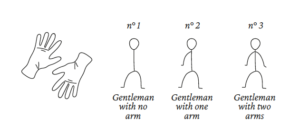
In case study n° 1, both gloves are superfluous. In case study n° 2 only one glove is superfluous. And in case study n° 3, no gloves are superfluous. Nevertheless, the pair of gloves remains the same.
What do these case studies teach us? That what is superfluous depends on context and is in no way a value judgment.
Let’s go back to case study n°3 and add a third glove.
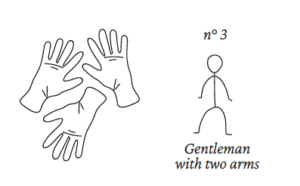
There’s now a superfluous glove in case study n° 3, but it won’t prevent our gentleman from keeping both hands warm. In other words, this third glove is neither good nor bad; it’s superfluous—beyond its intrinsic qualities. There could be eighteen gloves, and our gentleman would have the exact same day.
So:
Superfluousness is not a value judgment but a context-dependent state.
4.
Now here is our claim: there was a day, not so long ago, that made our world shift into a new context. However, allow us to elaborate further, especially as we find ourselves at the precipice of controversy; it is crucial to take a more didactic tone.
Let us examine a concept proposed in 2009 by an international team of twenty-six researchers: planetary limits. These are the thresholds humanity cannot exceed without compromising the favorable conditions in which it has developed; respecting these boundaries is necessary in order to preserve a safe and sustainable ecosystem. Without going into further detail, let’s just say that crossing a limit triggers to a cascade of problems. Since the year 2023, six out of nine of these limits have been exceeded.
If we take this study seriously (and we do), it goes without saying that once a planetary limit has been crossed, the global context changes, and we must therefore rethink our way of being (ideally, of course, we should rethink our way of being prior to crossing the line, but let’s be realistic: this never happens). Based on the same principle but using a less rigorous method, founded on unshakable convictions, we’ve defined the planetary limits of creation. It stems from a rather basic line of reasoning: if we consider that the quantity of creation exceeds human needs, then this limit has been crossed—and the negative effects outweigh the positive ones.
We’ve made various calculations to define a day of creative overload, a day when the production of creations exceeded humanity’s needs, i.e., February 27, 2013, the day Stéphane Hessel died. Since that day, we’ve transitioned from the mindset of “what I create is not superfluous” to “what I create is superfluous”. Acknowledging that the notion of superfluous depends on context, we’ve accepted that the context of the world changed on February 27, 2013. Stéphane Hessel’s death being one factor, the direction taken by the rest of humanity being another.
Regarding Stéphane Hessel’s death, we’re obviously dealing with a symbol, one that marks the end of an era and of a narrative loudly proclaiming that “to create is to resist, to resist is to create.” Let us note, for example, that around this period emerged the enthusiasm for what came to be known as content creators—and here we are concluding, through a crude analogy, that “to create content is to resist, to resist is to create content.” Give us a break!
As for the direction taken by the rest of humanity, we must only give one example: the day after Stéphane Hessel’s death, i.e. February 28, 2013, the French government presented Le Plan France Très Haut Débit, a proposal to cover the entire country with an ultra-high-speed broadband in less than ten years.
These two simultaneous events could not be more evocative: one world replaces another. Before, creation was the privilege of the few. At some point, and, according to us, it’s on February 27, 2013, creation becomes massive. With the widespread use of technological and digital tools and the increase in their performance, most people have become creators (of videos, for example. In 2013, 72 hours of video was uploaded every minute on Youtube, and that was already beyond comprehension. Even then, we didn’t have enough time in our lives to watch everything posted on Youtube in a single day).
This is the principle of User-Generated Content (UGC), the technical jargon used to describe any content—articles, images, videos, reviews, comments, or otherwise—created by ordinary users rather than professionals. This completely overturns the traditional model of creation. Creation, once reputed to be innovative, became the norm: from now on, it is all about creating to exist. Content creators must create in order to remain visible and to exist on social networks.
Thus, our relationship to creation changes, and so does the context in which it takes place. The next step involves re-evaluating the superfluous.
More precisely, the day of creative overload is, first and foremost, an awareness of the global situation of our world. It can be discussed, debated, and likely to change according to where we are in the world, and our own material and cultural environment, each one of us being able to define our own criteria and our own day for the surpassing of creation (to those who don’t think it’s arrived yet, we say: patience, the day will come). We’re giving the date of February 27, 2013, as an indication, because the moment seems decisive in our eyes. Since that fateful day, the number of creations has grown exponentially. Today, in 2024, no fewer than 500 hours of video are uploaded every minute on YouTube, adding to the billions of hours already in existence.
5.
So, let’s formulate our hypothesis as follows: since February 27, 2013, and until further notice, everything that has been created is superfluous.
We can already hear you say: “These people mix everything up.”
To this, we respond: do you know who we are? It’s time to tell you, though this information doesn’t change much in the grand scheme of things: we’re a few convinced people, gathered into a superfluous committee, driven by the force of the superfluous (the more cynical will label us as superfluous), recently converted or having always been, sporadically or totally affected, superfluity being such that it inexorably ends up rubbing off on everything it touches, initiating a chain of reactions—radioactive. Once struck by the evidence we wonder how we could have believed it otherwise.
To remind you: the day of creative overload is a feeling. As such, we can offer some food for thought, but we can’t convince you. Only those who already feel will understand and be able to act. For the rest, we’ll let time do its work.
We promised not to repeat it, but we feel it’s important to do so: superfluous is not a value judgment. Since February 27, 2013, everything that has been created is superfluous because the new context means that what’s been created is superfluous, quite simply, without judging the quality of the creations. If the context were to change once again (for example, a definitive halt to the Internet or an oil shortage), what’s superfluous could and should be revalued.
It would, of course, be possible to establish a hierarchy of the superfluous, considering the needs and intentions of the creators in their approach, but whatever its place on the scale of the superfluous, we think it’s time to put a name to it. To be honest about it.
We’re not calling for a halt to all forms of creation. We know it’s pointless, and we don’t even want to—as this manifesto proves. Human beings are made in such a way that they must fill their short time between birth and death with all types of creative activity. We could also say that “we have to keep busy.” Far be it from us, then, to take a stand on the many variations of degrowth, slowdowns and other shutdowns. On the contrary, we say: “Let’s create, people of all horizons, let’s create intensely.”
On the other hand, we encourage honesty by pointing out the superfluous nature of these creations. Create, yes, but create superfluously. Only in this way can we be in perfect harmony with our age: the age of the superfluous. Mastering the superfluous in the age of the superfluous is like mastering fire in the age of fire: it means not missing out on our time, not leaving the tool in the hands of the few. It means having the knowledge to refuse the superfluous that is imposed upon us. It means no longer having to put up with it but dominating it. When you start to become aware of the superfluous, you create a breach and open a new path in the superfluous jungle that surrounds us.
6.
On November 30, 2022, the day the first version of ChatGPT was launched, we officially launched The Superfluous Movement. Due to it being inevitable, superfluousness will be our ultimate goal – but in just the right proportions, a controlled, precise superfluous, one that speaks its name.
To create an intentionally superfluous material by explicitly naming it as such, in order to reappropriate the superfluous and reclaim our freedom – in other words, to defend superfluity in order to remain free.
No more, no less – superfluous.
Completed between Paris and Montreal by the Superfluous commitee
March 29, 2024